Most dogs don't hate nail trims. They hate being held still, surprised by a squeeze, or cornered by a tool they don't understand. That difference matters, because it tells you the solution isn't a firmer grip. It's a slower, more predictable process.
You can learn to find the quick, choose tools that suit your dog's nails and temperament, and build a routine that keeps a nervous dog calm instead of overwhelmed. It won't always be a one-minute job. It can still be a peaceful one.
Tools Matter More Than Technique
Dull or oversized clippers are behind a surprising number of nail-trimming disasters. A dull blade crushes and squeezes the nail instead of slicing it, and a dog who feels that once will remember it next time. Whatever you buy, replace or sharpen it when it starts to crunch rather than cut cleanly.
- Plier-style clippers are the workhorse for most medium and large dogs. Look for a sharp, replaceable blade and a size matched to your dog's nails.
- Scissor-style clippers work well for thick nails and give good control, but they take more hand strength.
- Guillotine clippers suit very small, thin nails. They tend to crush thicker nails, so many owners outgrow them fast.
- A rotary grinder files the nail down in small increments, which is forgiving when you're unsure where the quick sits. Introduce it slowly: the noise and vibration bother some dogs more than the clippers do. Touch the spinning drum to the nail for a second at a time to avoid heat buildup.
- Styptic powder (or a pinch of cornstarch in a real pinch) stops a small nick from bleeding. Keep it within reach, not in a drawer across the room.
- A non-slip mat under your dog's feet. Scrambling for traction makes everything harder.
How to Find the Quick Without Guessing
The quick is the blood vessel and nerve running down the centre of the nail. Cutting into it hurts and bleeds. On white or translucent nails it shows up as a pink shadow, and you can watch it recede as the nail grows out.
Dark nails hide it completely. Instead of estimating, work in thin slices. Take a small cut off the tip, then look straight at the cut surface. You're watching for a pale, chalky disc with a faint darker dot forming in the middle. That dot means the quick is close. Stop there, or take one more sliver if the dot is very faint.
Signs you're getting close
- The cut surface goes from a solid grey-white to a softer, slightly pinkish tone.
- A small dark circle appears in the centre of the nail.
- The nail feels slightly spongy rather than firm under the blade.
Cut small, then look. Cutting small and looking twice always beats one confident snip that goes too far. Angling the blade so it follows the curve of the nail, rather than squaring it off flat, also leaves a tidier edge. A nail that clicks on the floor when your dog walks is generally longer than it needs to be.
A Calming Sequence for Nervous Dogs
Success with an anxious dog comes from sequence, not speed. Build it like this:
- Pick the right moment. After a walk, when your dog is tired, beats mid-zoomies. Keep the room quiet. No other pets, no audience.
- Warm up with touch. Handle each paw for a few seconds, palm up, then let go and reward. Do this on days you're not trimming at all.
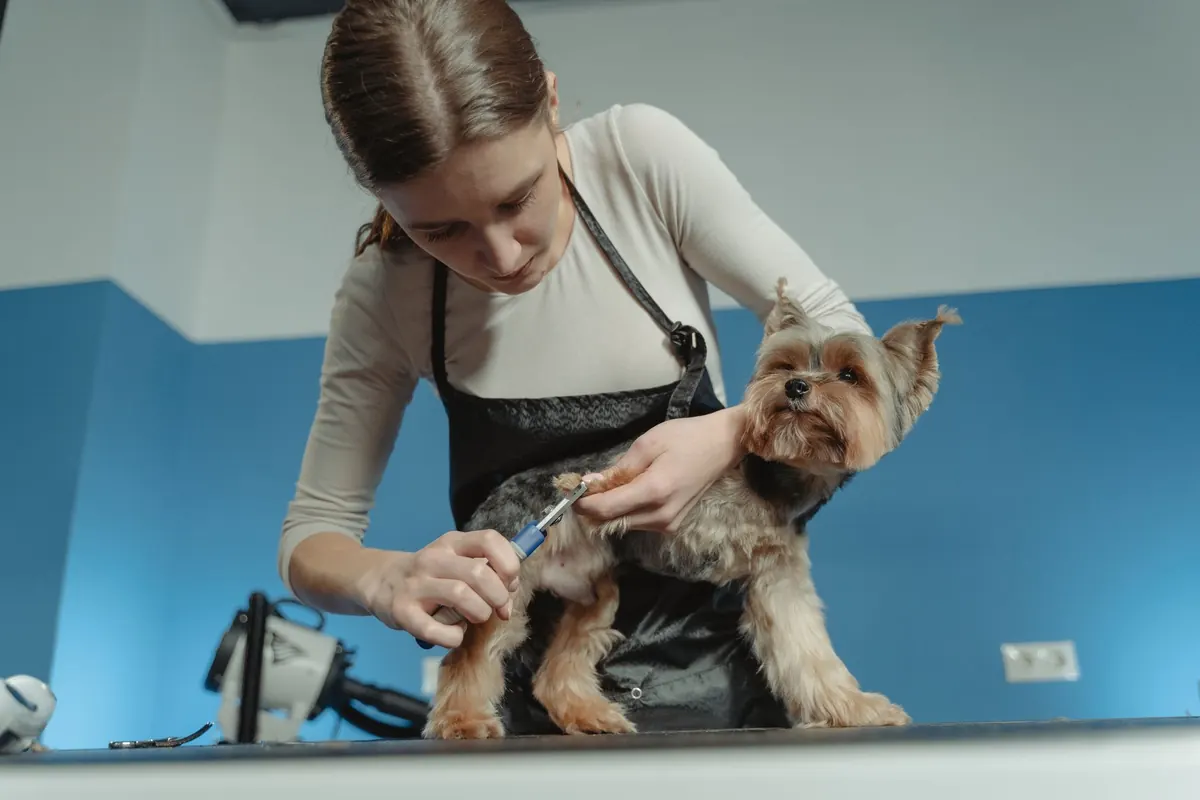
- Settle the paw. Cup the paw from underneath with your thumb resting on the pad and your fingers on top. Keep your grip loose. Never pull the leg out to the side or let it dangle — that's what makes dogs brace and pull back.
- Trim one nail. Reward immediately, then release the paw for a few seconds. Release is the reward that matters most to most dogs.
- Repeat while the dog is still relaxed. Work front paws first if they're easier. Stop the moment you notice tension.
- End on a win. If that's one nail, it's one nail. You'll finish the rest tomorrow, and tomorrow will be easier because today ended well.
Know When to Stop
Freezing is often mistaken for calm. A stiff, silent, still dog is not relaxed — it's shut down, and that's the moment bites happen. Other early signals include lip licking, yawning, turning the head away, a tucked tail, and wide-eyed side glances.
If your dog freezes, pulls hard, or snaps, end the session. A well-fitted basket muzzle is a fair and humane piece of safety equipment if your dog is genuinely frightened, and it lets their nails still get done without anyone getting hurt. If a nail is torn, ingrown into the pad, or bleeding that won't stop, that's a job for your vet or a groomer rather than a kitchen-table project.
Making the Next Trim Easier
The work between trims is where the real progress happens. Leave the clippers on the floor while you watch television, and reward your dog for sniffing them. Touch paws for two seconds at a time, several times a day, always followed by a treat. Tap the clipper against a nail without cutting, then treat.
If clippers are a hard limit, a scratchboard can be a genuine alternative for the front nails. Glue a strip of coarse sandpaper to a wooden board, teach your dog to paw at it for a treat, and the nails file themselves from the underside — slowly, but without any squeezing. Walks on pavement help too, though they rarely do much for the back nails.
A Few Nails at a Time Is Real Progress
One nail a day is eighteen nails in under three weeks. That's a full set, achieved without a single wrestling match. Pace beats force every time, and a dog who trusts the process will let you go a little faster next month than they did this one.
If your dog's nails are badly overgrown, curled into the pads, or you're seeing limping or swelling around a nail, get a professional to look at it before you trim further. For anything that looks like an injury or infection, ask your vet.
Photo: Tima Miroshnichenko / Pexels